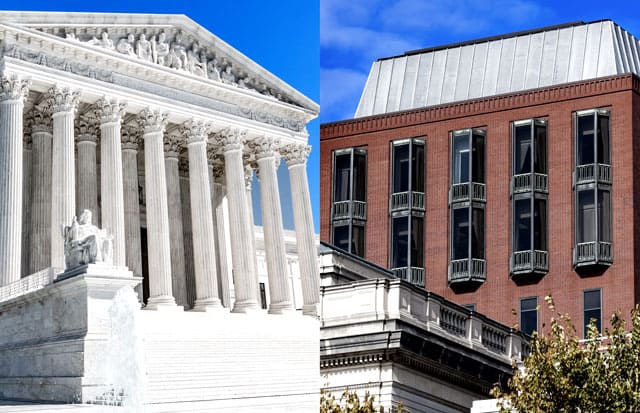

On June 10, 2019, the Supreme Court decided Return Mail, Inc. v. U.S. Postal Service, 139 S.Ct. 1853 (2019), a case that analyzes whether the Federal Government can avail itself of the three post-issuance review proceedings created under the America Invents Act of 2011, 35 U.S.C. § 100 et seq. (“AIA”). In a 6-3 opinion authored by Justice Sotomayor, the Court answered in the negative.
The AIA established three new procedures to allow persons to challenge the validity of issued patents. The new procedures are heard before the Patent Trial and Appeal Board (“Patent Board”). 35 U.S.C. § 6; H.R. Rep. No. 112-98, pt. 1, pp. 46-47. They are:
(1) An “inter partes review” that allows any “person” not the patent owner to petition for cancellation of claims by raising arguments that the invention lacks novelty or nonobviousness based on patents or printed publications in the prior art. 35 U.S.C. § 311;
(2) A “post-grant review” that allows any “person” not the patent owner to petition for cancelation based on any patentability ground. 35 U.S.C. § 321. To be timely, these proceedings must be brought within nine months of patent issuance. Id.; and
(3) A “covered business method review” (“CBM review”) that allows any “person” not the patent owner to petition for cancelation based on any patentability ground. AIA §§ 18(a)(1), (d)(1), 125 Stat. 329, note following 35 U.S.C. § 321; 35 U.S.C. § 321. Several prerequisites must be met for a person to file for CBM review. Id. For example, the subject patent must be one that relates to “data processing or other operations used in the practice, administration, or management of a financial product or service.” AIA § 18(d)(1). Further, CBM review can be filed only as a “defense against a charge or suit for infringement,” which ensures that the parties to a CBM review have a stake in the outcome. AIA § 18(a)(1)(B), 125 Stat. 330. A “charge … for infringement” has been interpreted to mean “a real and substantial controversy regarding infringement of a covered business method patent exists such that the petitioner would have standing to bring a declaratory judgment action in Federal court.” 37 C.F.R. § 42.302. In practice, a “charge … for infringement” likely includes a cease-and-desist letter that contains infringement allegations sufficient to give rise to declaratory judgment jurisdiction. No similar interpretation of “suit for infringement” exists. A CBM review petition can be filed at any time (i.e., there is no nine-month window as there is with a post-grant review). AIA § 18(a)(1)(B), 125 Stat. 330.
In this case, Return Mail, Inc. owns U.S. Patent No. 6,826,548 (“the ’548 patent”) that recites a method for delivering undeliverable mail. In 2003, Return Mail and the U.S. Postal Service had discussions regarding the Postal Service taking a license to Return Mail’s patent. No agreement was reached. A few years later the Postal Service launched an improved system to process undeliverable mail. In communications between the parties after the launch, Return Mail alleged that this new system infringed the ’548 patent. The parties did not reach a deal. Instead, the Postal Service petitioned for ex parte reexamination, which is a pre-AIA process for invalidating patent claims. In the reexamination, the Patent Office cancelled the original ’548 patent claims and issued new claims.
With new claims in hand, Return Mail sued the Postal Service in the Court of Federal Claims. In response, the Postal Service petitioned for CBM review. The Patent Board invalidated the claims and Return Mail appealed to the Federal Circuit. The Federal Circuit affirmed, holding that the Government is a “person” and therefore allowed to petition for CBM review. Return Mail, Inc. v. U.S. Postal Service, 896 F.3d 1350, 1365 (Fed. Cir. 2017).
The Supreme Court reversed and remanded. Return Mail, Inc. v. U.S. Postal Service, 139 S.Ct. 1853, 1868 (2019). The Court’s analysis began by noting that the patent statute does not define “person.” Id. at 1861. It then relied on a longstanding presumption of statutory construction that when a statute does not define the term “person,” it excludes the Government unless the context indicates otherwise. Id. at 1862-63. The Court then examined whether there was an affirmative showing in the AIA that the Government should be a “person” authorized to bring these three proceedings.
The Postal Service presented three arguments in support of overriding the presumption. The Postal Service asserted that the text of the AIA supports that the Government is a “person.” The Postal Service also cited to the long history of Government participation in the patent system implying that Congress intended for the Government to participate in AIA proceedings. The Postal Service further argued that because the Government is subject to liability for patent infringement under 28 U.S.C. § 1498, the AIA must allow it to use these mechanisms to defend itself. The Court rejected all three arguments.
First, the Postal Service asserted that multiple sections of the AIA refer to a “person” in contexts that clearly include the Government. Return Mail, 139 S.Ct. at 1863. The Postal Service identified 18 places in the AIA and the Patent Act where this was the case. Id. The Court acknowledged the general principle that when Congress uses a word in a statute, that word’s meaning should be used consistently throughout the statute, id., but nevertheless rejected the Postal Service’s argument because the 18 identified uses of the word “person” alternately include the Government, exclude the Government, or were unclear. The opinion cited to 35 U.S.C. § 207(a)(1) as an example of a section that is inclusive in nature because it allows the Government to apply for patents: “Each Federal agency is authorized” to apply for patent protection. Return Mail, 139 S.Ct. at 1864. Conversely, the opinion cited 35 U.S.C. § 2(b)(11) as an example of a section that is exclusive in nature: “allowing the Patent Office to cover the expenses of ‘persons’ other than federal employees attending programs on intellectual-property protection.” Id. The Court ultimately found that the AIA exhibits “no clear trend” of including the Government in the definition of “person.” Id. at 1863.
The Postal Service next argued that “the Federal Government’s longstanding history with the patent system . . . suggests that Congress intended to allow the Government access to AIA review proceedings.” Id. at 1865. The Court rejected this argument because “the Government’s ability to obtain a patent under § 207(a)(1) does not speak to whether Congress meant for the Government to participate as a third-party challenger in AIA review proceedings.” Id. The Court further noted that with respect to AIA review proceedings, “there is no longstanding practice: The AIA was enacted just eight years ago.” Id. One of the more persuasive arguments proffered by the Postal Service (and the dissent) was comparing AIA reviews to ex parte reexaminations proceedings. Added to the Patent Act in 1981, ex parte reexaminations permit “[a]ny person at any time [to] cite to the Office in writing … prior art … which that person believes to have a bearing on the patentability of any claim of a particular patent.” 35 U.S.C. §§ 301(a), 302(a). If the Patent Office determines that the new prior art raises “a substantial new question of patentability,” the Patent Office can reexamine the patent and invalidate some or all of the claims. 35 U.S.C. § 303(a). The Manual of Patent Examining and Procedure (“MPEP”) interprets “person” in the reexamination statute to include the Government. Return Mail, 139 S.Ct. at 1865. The Court quickly disposed of this argument by noting the “fundamental[]” differences between ex parte reexamination and the AIA petitions. Id. at 1865-66 (“Both share the common purpose of allowing non-patent owners to bring questions of patent validity to the Patent Office’s attention, but they do so in meaningfully different ways”).
In ex parte reexamination, the petitioner identifies prior art to the Patent Office and argues why it raises a question of patentability, but then has no further active role in the proceedings. “By contrast, the AIA post-issuance review proceedings are adversarial, adjudicatory proceedings between the ‘person’ who petitioned for review and the patent owner: There is briefing, a hearing, discovery, and the presentation of evidence, and the losing party has appeal rights.” Id. at 1866. Relying on the “fundamental differences,” the Court concluded that “there is nothing to suggest that Congress had the 1981 MPEP statement in mind when it enacted the AIA.” Id.
Lastly, the Postal Service argued that the Government must be a “person” allowed to petition under the AIA because it is subject to liability for patent infringement under 28 U.S.C. § 1498. The Postal Service suggested that it would be “anomalous to deny it a benefit afforded to other infringers—the ability to challenge a patent de novo before the Patent Office, rather than only as an infringement defense that must be proved by clear and convincing evidence.” Id. The Court, however, concluded that the Postal Service “overstates the asymmetry” because “[a]gencies retain the ability under § 282 to assert defenses to infringement . . . [and] like any other accused infringer, argue that the patent is invalid.” Id. “The Postal Service lacks only the additional tool of petitioning for the initiation of an administrative proceeding before the Patent Office under the AIA, a process separate from defending an infringement suit.” Id. at 1866-67.
The Court also noted that its ruling “avoids the awkward situation that might result from forcing a civilian patent owner (such as Return Mail) to defend the patentability of her invention in an adversarial, adjudicatory proceeding initiated by one federal agency (such as the Postal Service) and overseen by a different federal agency (the Patent Office).” Id. at 1867.
The dissent, penned by Justice Breyer and joined by Justice Ginsburg and Justice Kagan, would have affirmed the Federal Circuit. Justice Breyer asserted two main points. First, he noted the many instances in the Patent Act and the AIA where “person” is used to mean that it includes the Government. Id. at 1868. For example, Justice Breyer explained that the patent statutes allow the Government to obtain patents and raise certain defenses concerning intervening rights. Id. at 1869. Justice Breyer next criticized the sections of the patent statues that the majority relies on where “person” does not include the Government. Id. Specifically, he called these provisions “details of administration” and in criticizing 35 U.S.C. § 2(b)(11), which concerns how employees get reimbursed for travel related to intellectual property, he stated “governments as entities do not travel, attend events, or incur expenses for ‘subsistence’ or ‘lodging’; only their employees do.” Return Mail, 139 S.Ct. at 1869. In sum, Justice Breyer concluded that it “makes little sense to presume that the word ‘person’ excludes the Government, for the surrounding provisions point to the opposite conclusion.” Id. at 1870.
Second, Justice Breyer highlighted the statutes’ legislative history and executive interpretation through, e.g., the MPEP to show that “person” includes the Government. Id. at 1870. He pointed to the legislative history of these new procedures and explicated that they were enacted with the goal of making it easier to challenge “questionable patents.” Id. According to Justice Breyer, nothing in the legislative history supported an interpretation that Congress meant to allow a civilian patent owner accused of infringement the right to rely on these procedures but not the Government. Id.
Justice Breyer also responded to the majority’s concern about the “awkward” situation that allegedly would result if one federal agency of the Government sought to challenge a civilian patent owner’s patent rights using another federal agency. In his view, there was nothing “awkward” at all especially given that the Government has been able to file ex parte reexaminations since 1981. Return Mail, 139 S.Ct. at 1871. Further, Justice Breyer noted that these AIA provisions allow civilian patent owners to challenge a federal agency’s patent (e.g., the Department of Defense) where the Patent Office will be adjudicating the patent’s validity. Id. In other words, “the situation the majority attempts to avoid is already baked into the cake.” Id.
As a result of this holding, the Government cannot bring petitions under the AIA. In practice, this will reduce the options the Government has to invalidate patents and thus, could increase the leverage of parties negotiating licenses with the Government.